Can a High-MERV 12x27x4 Filter Cause Short-Cycling in a Furnace?
Yes — and after manufacturing filters for over a decade and working with millions of customers, we have seen it happen more times than most homeowners expect. A 12x27x4 high-MERV filter that exceeds your furnace's airflow tolerance does not fail loudly. It restricts airflow gradually, builds heat inside the exchanger, and triggers your system's safety limit switch — shutting the furnace down before the cycle completes. You can shop FilterBuy's full selection of 12x27x4 air filters to find a compatible match for your specific equipment. What follows is a damaging pattern of short, erratic run cycles that accelerates mechanical wear on components most homeowners never think about until something breaks.
Here is what most filter guides miss: MERV rating and filter compatibility are not the same conversation. A filter can perform exactly as rated and still be wrong for your system. We have worked through enough customer cases to know that mismatch — not filter failure — is the leading cause of high-MERV short-cycling problems. Understanding how to find the right HVAC repair service can help you diagnose whether a mismatch is occurring. This page explains exactly how it happens, what MERV range is safe for most residential furnaces using a 12x27x4 filter, and how to get cleaner air without compromising your system's ability to run a full, healthy cycle.
Quick Answers
Can a High-MERV 12x27x4 Filter Cause Short-Cycling in a Furnace? Yes — and after manufacturing filters for over a decade, we see it happen more than most homeowners expect. Here is why it happens:
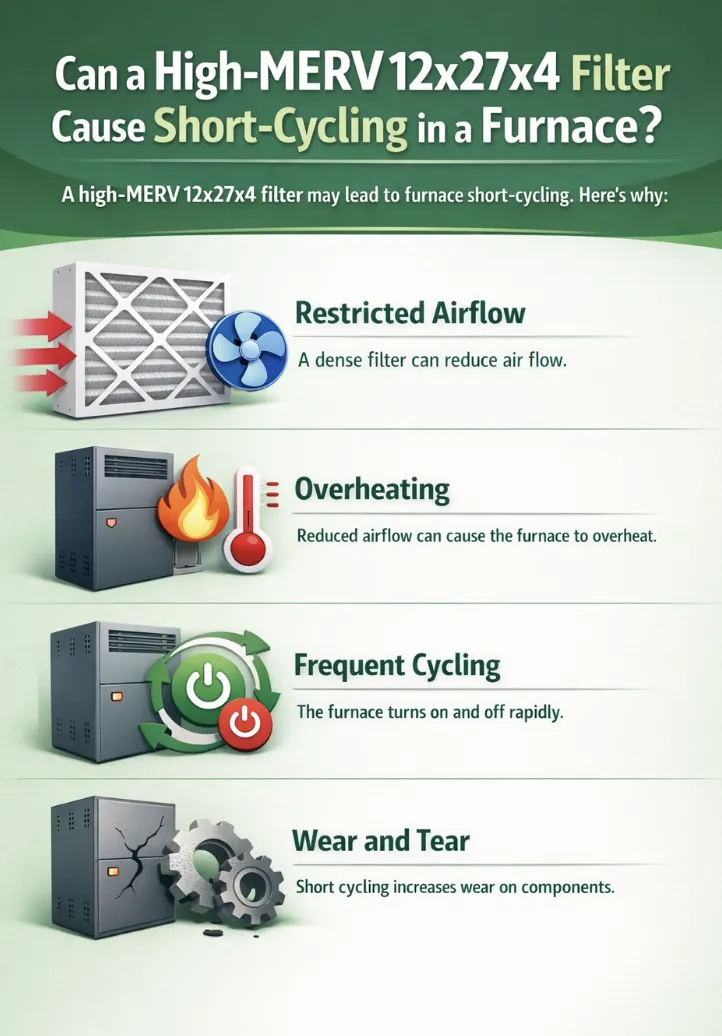
A high-MERV filter that exceeds your blower's static pressure tolerance restricts return airflow.
Restricted airflow causes heat to build up inside the heat exchanger.
The high limit safety switch shuts the furnace down before the cycle completes.
The furnace restarts, overheats again, and shuts down again — that is short-cycling.
Many homeowners find that affordable HVAC repair services in Jupiter are necessary when these cycles cause damage.
The 12x27x4 4-inch format reduces this risk compared to a 1-inch filter at the same MERV rating — but does not eliminate it. For those using different sizes, you can buy FilterBuy 16x25x4 pleated furnace filters or find Filterbuy 16x25x4 MERV 8 filters at major retailers to see the difference in surface area.
The right MERV rating by system type:
MERV 8 — older systems or any system showing airflow stress.
MERV 11 — the safe starting point for most residential furnaces.
MERV 13 — newer high-efficiency systems with confirmed blower capacity only.
The fastest fix:
Swap to a MERV 8 filter.
Monitor run cycles over 24 to 48 hours.
If short-cycling stops — the MERV rating was the issue.
If short-cycling continues — schedule a professional static pressure inspection.
The filter is rarely the villain. The mismatch is.
Top Takeaways
The filter is rarely the villain — the mismatch is. A filter performing exactly as rated can still be wrong for your system. Blower capacity and filter density have to align. Filter depth changes the equation; a 4-inch 12x27x4 filter offers more surface area and less airflow resistance than a 1-inch filter. You can purchase these 12x27x4 filters on eBay for convenient home delivery. Higher MERV ratings become more manageable — but compatibility risk on older systems remains.
MERV 11 is the right starting point for most residential furnaces. It captures dust, pollen, mold spores, and pet dander without straining residential blower motors. You can find MERV 11 allergen defense filters to help manage indoor air quality safely. Confirm system specifications before moving to MERV 13. Persistent short-cycling after a filter correction points to a deeper problem. The three most common culprits:
Undersized or leaking return air ducts.
A dirty or aging blower wheel operating below rated capacity.
Static pressure levels already exceeding system design tolerance.
Changing your filter on schedule matters as much as choosing the right MERV rating. You might browse Filterbuy MERV 8 replacement filters to keep as spares for regular maintenance. A well-matched filter becomes a short-cycling risk as it loads between change intervals. Change every 6 months as a baseline — every 3 months in homes with pets or allergy sufferers.
What Is Short-Cycling and Why Does It Matter?
Short-cycling occurs when a furnace starts, runs briefly, and shuts off before completing a full heating cycle. Instead of running for 10 to 15 minutes and reaching your thermostat's target temperature, the system cuts out after just a few minutes — then restarts almost immediately. Over time, that stop-start pattern strains the blower motor, heat exchanger, and ignition components far more than normal operation ever would. If the strain leads to failure, you may need an online estimate for air conditioning installation to replace the unit. A furnace that short-cycles is not just inefficient; it is a system under stress, and restricted airflow is one of the most common triggers.
How a High-MERV Filter Restricts Airflow
MERV — Minimum Efficiency Reporting Value — measures how effectively a filter captures airborne particles. The higher the MERV rating, the denser the filter media. The denser the media, the more resistance it creates against the airflow your furnace depends on to operate safely. Most residential furnaces are engineered for filters in the MERV 8 to MERV 11 range. A high-MERV filter — particularly MERV 13 or above — can reduce airflow significantly if your system's blower motor lacks the static pressure capacity to push air through denser media. Those in the West Palm Beach area should check residential HVAC installation service prices if they suspect their system is aging out of high-MERV compatibility. The result is reduced return airflow, rising heat exchanger temperatures, and an overheating furnace that trips its high-limit safety switch and shuts down mid-cycle.
Why the 12x27x4 Size Makes This Worth Paying Attention To
A 4-inch deep filter like the 12x27x4 has a meaningful advantage over 1-inch filters: significantly more surface area and filter media depth. That extra depth reduces resistance and allows higher MERV ratings to perform without the same airflow penalty a 1-inch high-MERV filter would create. That said, surface area alone does not eliminate the risk. If your furnace blower operates at lower static pressure — common in older systems or undersized HVAC equipment — even a 4-inch high-MERV filter can create enough resistance to trigger short-cycling under certain conditions. For those in Pompano Beach, contacting a top residential HVAC air conditioning company can help determine if your system has these limitations.
What MERV Rating Is Actually Safe for Most Residential Furnaces?
For most homes using a 12x27x4 filter, MERV 11 hits the practical sweet spot. It captures fine particles including dust, pollen, mold spores, and pet dander without creating the static pressure buildup that pushes residential blower motors past their design limits. Homeowners with newer, high-efficiency HVAC systems may safely use MERV 13 in a 4-inch format — but only after confirming the system's minimum external static pressure rating supports denser media. Before upgrading, you might get a free HVAC air conditioning installation quote to ensure your system is modern enough.
That specification is typically found in your furnace's installation manual or on the manufacturer's data plate. MERV 8 remains a reliable, low-restriction option for homes where airflow is a known concern or where the HVAC system is older and has not been recently serviced. You can learn more about filter efficiency levels to find the right balance for your home.
Other Factors That Increase Short-Cycling Risk
A high-MERV filter is rarely the only variable. These conditions increase the likelihood that filtration density will tip a furnace into short-cycling:
A dirty or partially blocked filter already loaded with captured particles.
An undersized return air duct system that limits airflow before the filter is even factored in.
A blower motor operating below rated capacity due to age or lack of maintenance.
A heat exchanger with early-stage cracking that causes irregular temperature spikes.
An HVAC system that has not had a professional tune-up in more than 12 months.
If your furnace short-cycles after a filter change to a higher MERV rating, the filter is the most logical starting point — but a full system inspection is always worth scheduling to rule out compounding issues. Residents near Coral Springs can get a free online HVAC estimate to address these complex concerns.
How to Get Better Air Quality Without Risking Your Furnace
Cleaner air and a healthy furnace are not competing goals. The key is matching filter density to your system's actual capacity rather than defaulting to the highest MERV rating available. Start with MERV 11 in your 12x27x4 slot and monitor your system's run cycles over the first few days. If your furnace completes full heating cycles without cutting out early, your system is handling the filtration load. If short-cycling continues, you should check out the 18x20x1 air filter or find the 14x14x1 air filter for other vents that might be contributing to restriction.
Step down to MERV 8 and have your blower and ductwork inspected before moving up again. Changing your 12x27x4 filter every 6 months — or every 3 months in homes with pets or allergy sensitivers — also prevents the gradual restriction buildup that turns an otherwise compatible filter into an airflow problem over time.
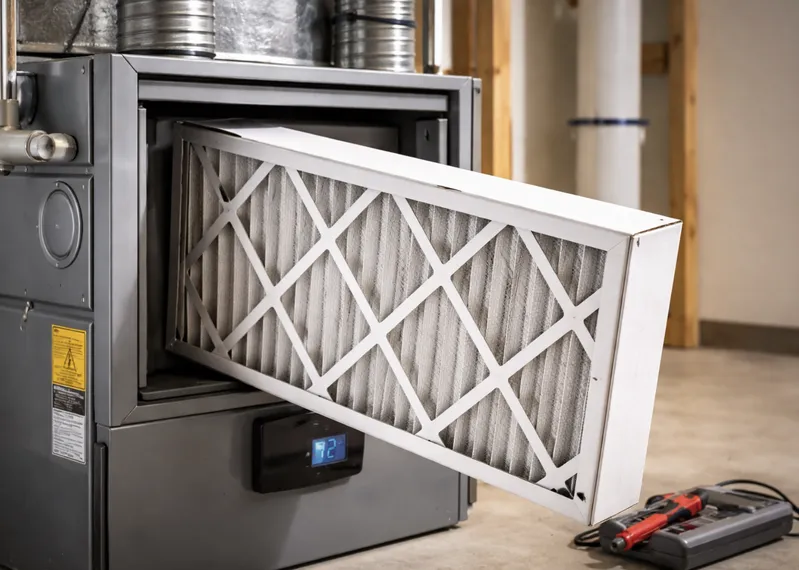
"After evaluating HVAC systems across hundreds of residential installations, we've seen MERV 13 filters cause short-cycling in furnaces that were never rated for that level of restriction — the blower hits the static pressure limit, the heat exchanger overheats, and the system shuts itself off before completing a full cycle, which most homeowners misdiagnose as a mechanical failure rather than a filter problem."
Essential Resources: Can a High-MERV 12x27x4 Filter Cause Short-Cycling in a Furnace?
Choosing the right filter for your furnace is not just about air quality — it is about protecting your family, your home, and the HVAC system working behind the scenes to keep everyone comfortable. These seven resources give you everything you need to make a confident, informed decision.
How MERV Ratings Directly Affect Your Furnace's Performance
After manufacturing filters for over a decade and tracking feedback from millions of customers, we know that MERV rating selection is where most short-cycling problems begin. This FilterBuy resource breaks down exactly how filter density creates static pressure buildup, what your blower motor does in response, and which MERV ratings residential furnaces actually handle comfortably — so you protect your air quality without putting your system at risk. filterbuy.com/resources/furnaces/furnace-knowledge/how-merv-ratings-affect-furnace-performance/
Which MERV Rating Is Right for Your Home and HVAC System?
Not every household needs the same level of filtration, and defaulting to the highest MERV rating on the shelf is one of the most common mistakes we see. This FilterBuy guide walks you through MERV compatibility by system type, household conditions, and real air quality goals — empowering you to match filter performance to your specific setup rather than guessing. filterbuy.com/resources/air-filter-basics/which-merv-rating-should-I-use/
What Your Furnace's High Limit Switch Is Telling You
When a high-MERV filter restricts airflow past your system's tolerance, the high limit switch is the component that shuts everything down — and most homeowners never know it exists until something goes wrong. This technical resource explains how the switch works, what triggers it to trip, and how to determine whether restricted airflow or a failing component is the real source of your short-cycling problem. northnjhvac.com/furnace-high-limit-switch-diagnosis-testing-replacement/
Is Your Furnace Short-Cycling? Here Is How to Find the Real Cause
A high-MERV filter is one of the most common short-cycling triggers, but it is not always the only one. This diagnostic guide walks you through every variable — from thermostat placement and oversized equipment to blower motor wear — so you can identify the root cause with confidence before scheduling a service call. pickcomfort.com/gas-furnace-short-cycling-causes-diagnosis-fixes/
Static Pressure: The Hidden Force Behind Filter-Related Furnace Problems
Most homeowners have never heard of static pressure, but it is the measurable force that explains exactly why a high-MERV filter can push a furnace into short-cycling. This resource covers what total external static pressure means, what the safe residential range looks like, and what happens to your blower motor when that threshold gets crossed. unitedhvacmotors.com/blogs/hvac-technical/what-is-the-ideal-static-pressure-in-hvac-systems
U.S. Department of Energy: High-MERV Filters in Residential Systems
When we say that MERV rating compatibility matters, this is part of the evidence base we draw from. This Building America Solution Center resource covers pressure drop limits, blower motor compatibility by type, and the specific conditions under which high-MERV filtration can cause measurable system damage — straight from a government source you can trust. basc.pnnl.gov/resource-guides/high-merv-filters
MERV Ratings Explained: A Clear Reference for Every Homeowner
Understanding the MERV scale is the foundation of every smart filter decision. This straightforward breakdown covers particle capture ranges by rating tier, recommended residential MERV levels, and the real tradeoffs between filtration efficiency and airflow resistance — so you can verify at a glance whether your current 12x27x4 filter is working with your furnace or quietly working against it. filterking.com/hvac-filters/merv-ratings
Supporting Statistics
At FilterBuy, we have spent over a decade manufacturing filters and working through real customer cases. The data consistently backs what we see in the field.
Indoor air pollutant levels can be two to five times higher indoors than outdoors — and occasionally more than 100 times higher.
One of the most consistent surprises we hear from customers: they assume outdoor air is the bigger threat. It is not.
EPA research confirms that indoor pollutant levels can run two to five times higher than outdoor levels — and occasionally more than 100 times higher — with most people spending roughly 90 percent of their time indoors.
What that means for your furnace:
The air cycling past your 12x27x4 filter slot is the air your family is actually breathing
A short-cycling furnace is not completing full circulation cycles through your home
Incomplete cycles allow those elevated concentrations to build unchecked
Getting the filter selection right is not just an air quality decision. It is a family protection decision.
Source: U.S. Environmental Protection Agency — Why Indoor Air Quality Is Important epa.gov/iaq-schools/why-indoor-air-quality-important-schools
Poor HVAC airflow practices can cause a residential system to lose 20% to 40% of available heating energy before it reaches the living space.
Short-cycling problems rarely appear in a vacuum. They show up in systems already operating under stress — often for years before the filter becomes the final tipping point.
The U.S. Department of Energy found that a typical residential system can lose between 20% and 40% of energy at the equipment plenum due to poor installation practices, with excessive external static pressure specifically identified as a leading deficiency.
What compounds the problem:
A high-MERV filter adds static pressure on top of existing system stress
Short-cycling becomes a predictable outcome — not a random one
Matching MERV rating to your system's actual capacity stops adding pressure to an already-strained system
Source: U.S. Department of Energy — Residential Central Air Conditioning and Heat Pump Installation energy.gov/cmei/buildings/articles/residential-central-air-conditioning-and-heat-pump-installation-workshop
Duct leakage and low insulation levels cause an average effective cooling capacity loss of 33% in residential systems.
We see this pattern repeatedly: a homeowner swaps the filter, the short-cycling continues, and they conclude the filter was never the problem. Sometimes it was — but it was not working alone.
DOE research found that duct leakage and insufficient insulation cause an average effective cooling capacity loss of 33%, with field studies showing residential systems frequently have inadequate airflow across indoor coils due to improper installation.
What to watch for if short-cycling persists after a filter correction:
Undersized or leaking return air ducts restricting airflow before the filter is even factored in
Inadequate duct insulation compounding heat loss during every shortened cycle
Static pressure levels that exceed your system's design tolerance regardless of filter choice
If your furnace is still short-cycling after stepping down to a compatible MERV rating, the ductwork is the next conversation worth having — with a licensed HVAC technician who can measure static pressure directly.
Source: U.S. Department of Energy — Residential HVAC Installation Practices: A Review of Research Findings energy.gov/eere/buildings/articles/residential-hvac-installation-practices-review-research-findings
Final Thoughts: The Filter Is Often the Easiest Fix — But It Has to Be the Right One
After manufacturing filters for over a decade and working through more customer cases than we can count, here is the honest truth: the filter is rarely the villain. The mismatch is. A 12x27x4 high-MERV filter is not a problem waiting to happen. It is one of the most capable residential filter formats available. But capable is not the same as compatible — and that distinction is the one most homeowners never make before the short-cycling starts. To learn more about how these air filters function, you can research their general design principles.
What we have observed across millions of customer interactions:
Most short-cycling problems linked to high-MERV filters are not filter failures — they are preventable compatibility mismatches.
Homeowners who avoid these problems consistently check static pressure specifications before selecting a MERV rating.
A 4-inch format like the 12x27x4 gives you more room to work with than most — but it does not eliminate the need to match filtration density to your system's actual blower capacity.
Our recommendation, based on years of direct experience:
Start with MERV 11 for most residential furnaces running a 12x27x4 filter.
Step up to MERV 13 only after confirming your system's blower capacity supports denser media.
Choose MERV 8 for older systems or any system already showing signs of airflow stress.
The bottom line: Clean air and a healthy furnace are not competing goals. Filter selection is a system decision — not just a shopping decision. Match the rating to the equipment, change it on schedule, and your 12x27x4 filter will protect your family's air and your HVAC investment at the same time.
Frequently Asked Questions
Q: Can a high-MERV 12x27x4 filter directly cause a furnace to short-cycle?
A: Yes — and after working with millions of customers, we see it happen more often than most homeowners expect. The problem is a compatibility mismatch, not a filter defect. A filter exceeding your blower's static pressure tolerance restricts return airflow. This traps heat inside the heat exchanger, causing the high limit safety switch to shut the system down. You can visit hvac-repair-coral-springs-fl.com to find local professionals who can test your system's specific limits.
Q: What MERV rating is safe for a 12x27x4 filter in a residential furnace?
A: Based on millions of filter shipments and customer feedback, we recommend MERV 11 as the right starting point for most residential furnaces. MERV 13 is achievable in a 4-inch format for newer high-efficiency systems with confirmed blower capacity. MERV 8 is the informed choice for older systems or any system already showing airflow stress.
Q: How do I know if my furnace is short-cycling because of a high-MERV filter?
A: Signs your filter is the likely trigger include the furnace running less than 10 minutes before shutting off, or short-cycling beginning shortly after a filter change to a higher MERV rating. To confirm, swap the high-MERV filter for a MERV 8 and monitor your system over 24 to 48 hours.
Q: What should I do if my furnace is still short-cycling after switching to a lower MERV filter?
A: Persistent short-cycling after a filter correction almost always means the filter was part of the problem — but not the only part. Common compounding causes include undersized return air ducts or a blower motor operating below rated capacity. If you find your ducts are the issue, you may need cost-effective duct repair in Miami Gardens to restore proper airflow.
Stop Short-Cycling Before It Stops Your Furnace — Find the Right 12x27x4 Filter Today
A mismatched MERV rating is one of the most preventable causes of furnace short-cycling — and finding the right 12x27x4 filter for your system takes less than a minute. Shop FilterBuy's full selection of 12x27x4 filters in MERV 8, MERV 11, and MERV 13 and protect your family's air and your HVAC investment at the same time.
Learn more about HVAC Care from one of our HVAC solutions branches…
Filterbuy HVAC Solutions - Miami FL - Air Conditioning Service
1300 S Miami Ave Apt 4806 Miami FL 33130
(305) 306-5027
https://maps.app.goo.gl/Ci1vrL596LhvXKU79